Thursday, 19 March 2015

Travels within myself: Connaught Place, circa midnight

The dog comes zooming in urgently from my right and vanishes straight into the wall between two shops. Astonishing as it is, it does not feel impossible in this witching hour. The white colonnades of Connaught Place are gleaming in part moonlight, part neon-glow. Light is falling almost everywhere. The lamps in the inner circle shining on locked up cigarette stands; the oranges and yellows of ads brightening up closed shutters.

In this crowd of light there is a solitude of people. In the last block, there was a guard on night duty, eating a late dinner with his back turned determinedly towards the world – which wasn't there. In the next block, there is another guard who has befriended a homeless man and they sit on a shared blanket swapping desultory stories, as one who cannot go to sleep and one who is not allowed to. In this block, there is only the dog. Or was, till he vanished into the wall.


As suits a midnight mystery, the solution of the dog's vanishing act is even more enigmatic. Between the two shops in A Block is this narrow entrance to a corridor, which we have never spotted in 25 odd years of roaming the inner circle. It is more astonishing than the vanishing dog. Maybe it only appears at night?

What is happening is that the city is opening up to me. More and more they will appear now, as i roam around with only risk and release for companions: the corridors, the doorways, the tunnels, the apertures, and pipelines and gaps and secret holes in the wall. Just this now, it has opened up in a narrow and long portal that leads to a speck of light at the end of the tunnel.

Alone, at about 11.45 at night, i don't have the confidence to enter it. I will come again when we both have more light. It will lead, i know, to some backyard between the inner and middle circles, with restaurant bins, fire escapes, and maybe a Peepal tree. And to a dog resting content, having reached his destination.

Tuesday, 3 February 2015

The Laughter Memoirs - JNU 6


Tara came into our lives – which were unfolding like the unhurried alaap of some all-night classical performance – like Shammi Kapoor playing the drums. An American research scholar visiting to experience India, she sucked enthusiastically at the straw of us. With her smile, questions, earrings and accent equally bright, she sponged up local political debates, academic gossip, university course structures, activists’ passions, friends’ lives, professors’ opinions, group dynamics, dhaba coffees, and late-night rums.

On some somnolent morning, with the koel providing background music to several unshaven youth sipping at the news of the day, Shuvi and I would be figuring whether to brush our teeth first, or put on music first, when the door would burst open. Tara would enter like a happy typhoon. Our room was her base during this visit, and she kept her sleeping bag and clothes there, while traversing the city and beyond with a comb, toothbrush and kaajal in her pocket. Her ‘hiii’ entered every lazy, class-bunking crevice of the morning. Our pace of becoming upright on our beds would quicken and we’d switch on all senses to receive her full flavor. “TK is leaving for Chaibasa today”, she’d beam breathlessly at us. “She says I can come along too” (pulling out her sleeping bag). “There’s a train in a couple of hours” (taking off her clothes). “I’ll be gone for a few days” (pulling off her undergarments).

At this point Shuvi would sit up yet straighter, wearing a persona so solemn that only an 18-year-old could have conjured it, her face eloquent with respect for the serious business of travelling to the Indian hinterland to search for Indian Reality, and her demeanor designed to say: I find nothing unusual at all in my roommate’s friend taking off all her clothes in front of me, happens every day. Like the rest of us, Shuvi too had figured in some inchoate way that in this new life, some things made you seem establishmentarian, and would not do. Before we had quite fathomed the landscapes of ticketless train travel, political hotbeds, and going off alone to be with utter strangers that Tara had drawn up for us, she’d be gone with an energetic “bye darlings!”. We loved her.

I watched with interest as a parade of young male activists from Delhi’s radical circles came calling to my hostel for visiting, picking up, dropping, or otherwise engaging Tara. They tended a lot to blank verse in Hindi. Off she would go, leaving behind a trail of feminist positions, applied political theory, vigorous debate, self-reflexive questioning… and in her place would blossom notebooks filled with poems titled “Upon your leaving”, or “Yesterday, she said…” and, of course, “Silently I celebrate my defeat at your hands”.

On the average drinking evening, Tara could be counted on for some stunning singing and essential insights into international academia, such as what Jacques Derrida’s accent sounded like. On one such evening, Raghav graced us with his presence (remember: He who felt that anyone who didn’t lend him a pen was a property-loving bourgeoise?). After three typically silent pegs, consumed as he slunk in a corner of Naga’s room, he decided to bring some much-needed sharp and penetrating insight into what clearly seemed to him like a vapid, futile discussion.

He put down his glass with a dramatic bang. Drew himself up to his full 5-feet height. Marched across the room to Tara. And astonishingly managed to assume a posture that was both a pugilist’s crouch and the chest-puffing stance of one about to declaim meaningfully. Then, he narrowed his eyes critically and sneered, “American academic, eh? American academic?” And, having left us with this path breaking insight, walked off, muttering “American academic!” Par for the Raghavian course for us, this was Tara’s first sighting of Raghav. We turned to her for comment. She beamed with delight: “It is a very remarkable young thing”, she declared.

On an early such occasion, the niceties of using the male hostel loo were introduced to Tara. She was uncomprehending but enthusiastic. That day, both she and I needed to – as we had taught her in our most elegant, classical Hindi – do susu. It was Naga’s room and he guided us down the corridor and beyond the single palm languishing near the toilets. He was like the lead hunter stalking the savannah. He was full of advice, strategy, admonition, warning and threat. “Now, stand near this plant”, he said as Tara gazed giggly and wide-eyed. “Take it seriously or I’ll get into trouble”. She gathered herself soberly. “I’ll go in and if no one is inside, I’ll call you. Then, if someone comes while you are in the loo, I’ll cough. Just stay inside and only come out when I say so.” Tara nodded soberly.

We went in and bolted the two cubicles. Naga stood guard. At this point, an unfortunate young man did come in to use the open urinal. Naga duly coughed. And in its most delightful, mellifluous, American-accented avatar, Tara’s voice sang out, “Nagaaaa, does that mean you don’t want us to come ouuuut???”


And that explains why a young man from 1991 is still standing there, frozen in mid-arc, in the ground floor loo of Kaveri hostel…

Thursday, 1 January 2015

The Laughter Memoirs - JNU 5

It is a full moon night.

What choice does it have?

Down a midnight road devoid of people or traffic, a tall metallic ladder is rolling along in aluminium harmony. It is the kind electricians use to reach high cables, with two ladders joining up to make a platform on top, and four wheels beneath. Two people are pushing the contraption along. They are not electricians. They are Dev and Siddharth.

Nor is the man perched on top of the ladder an electrician. He is, in fact, playing the flute. Krishnaji is the silent presence amid our babble. He is several years older than us and – to my newcomer’s eyes – infinitely wiser. He is doing his PhD at the same glacial pace as much of the rest of the campus, but manages to bring style and dignity to the performance aided by an impressive moustache and a slow-burning smile. By and large, in our liquid evenings, no one pulls his leg.

A fine connoisseur of Hindustani classical music, Krishnaji is now playing a night raag. Looking back on the occasion 25 years later, I see clearly how this was exactly the right thing to do: play the flute, at midnight, when high on grass, atop an electrician’s ladder, pushed by similarly enthused friends, on the enchanted roads of the university. It’s astonishing nobody had thought of it before.

We are all sitting at Ganga Dhaba, as the ladder approaches. Those who have not managed to collect enough money to get their evening’s drink are drowning their sobriety in tea. Those who have finished their quota but have not actually passed out, are nursing their drunkenness – that razor sharp clarity on what should be done about the burning issues of the day which only a 4th peg can bring – also with tea. Rohit is desperate for a non-veg dinner but the dhaba extends itself only to eggs. I’m consoling him with adapted Kishore Kumar songs. “Meat na mila re mann ka”, I offer. He cheers up and counters with “Raat haddi ek kabab mein aayi...”. Subroto is convincing people that he personally saw a girl from Ganga Hostel come to the dhaba with a flask and say, “Bhaiya, do cup chai daal dena... oopar tak bhar dena”. A group of students is playing Antakshari in the distance. Brisk sales of bun-omelettes and coffee, couples returning from the late night movie at Priya cinema, a pamphlet being composed, motorcycles parked near the footpath...

And all the time the ladder approaches with its musical burden.

At this point, higher reality intervenes in the shape of a tree. An inquisitive branch cranes its neck to see what the commotion is all about and Krishnaji gets entangled in it. History does not record if he cries out but Dev and Siddharth move on, unaware of the contretemps above. We don’t know what combination of falling and scrambling brings our flautist down to the earth, but when he limps his way to the dhaba it is evident he did not fall gently like the quality of mercy. Dev goes off towards the dark hinterlands of the dhaba in a vague but determined quest for Herbs That Heal – he is sure they are there somewhere. Siddharth sits silently, and nods gently and often. Useless suggestions are made. The night falls on arranging how an injured Krishnaji should be delivered to his hostel room.

The next morning has a certain charge to it. It seems that Krishnaji has actually given the world a chance to – if not laugh, then – chortle gently at him. At around 11.30 or so, various shapes and sizes of freshly-bathed, hungover, hungry, caffeine-deprived, class-bunking, library-pretending bipeds start homing in on the library canteen. Soon Krishnaji appears on the horizon, a couple of band-aids in tow. There is a lull, and then someone asks casually and with screaming insouciance, "kya, Krishnaji, suna hai kal raat kucch ho gaya? Gir-vir gaye kya?"  


Krishnaji closes the matter with a one-liner: “Nahin saathi, wo, kal hum prakriti ke kucch zyaada kareeb aa gaye thhe...” 

Friday, 29 August 2014

The Laughter Memoirs - Dehradun 3

Years later, when I called up home from a sweltering Delhi in July – full and tense like a fat raindrop hanging from the roof ledge and unable to fall – I would try to recover some of the heady atmosphere of the mossy, incessant, cold rain of my childhood. On phone, my laughing Ma would put my yearning in place. Yes, saawan-bhado is here, she’d say… yes, you’re right, it’s indeed barkha bahaar... and the whole house is fragrant with the smell of wet dog…”.


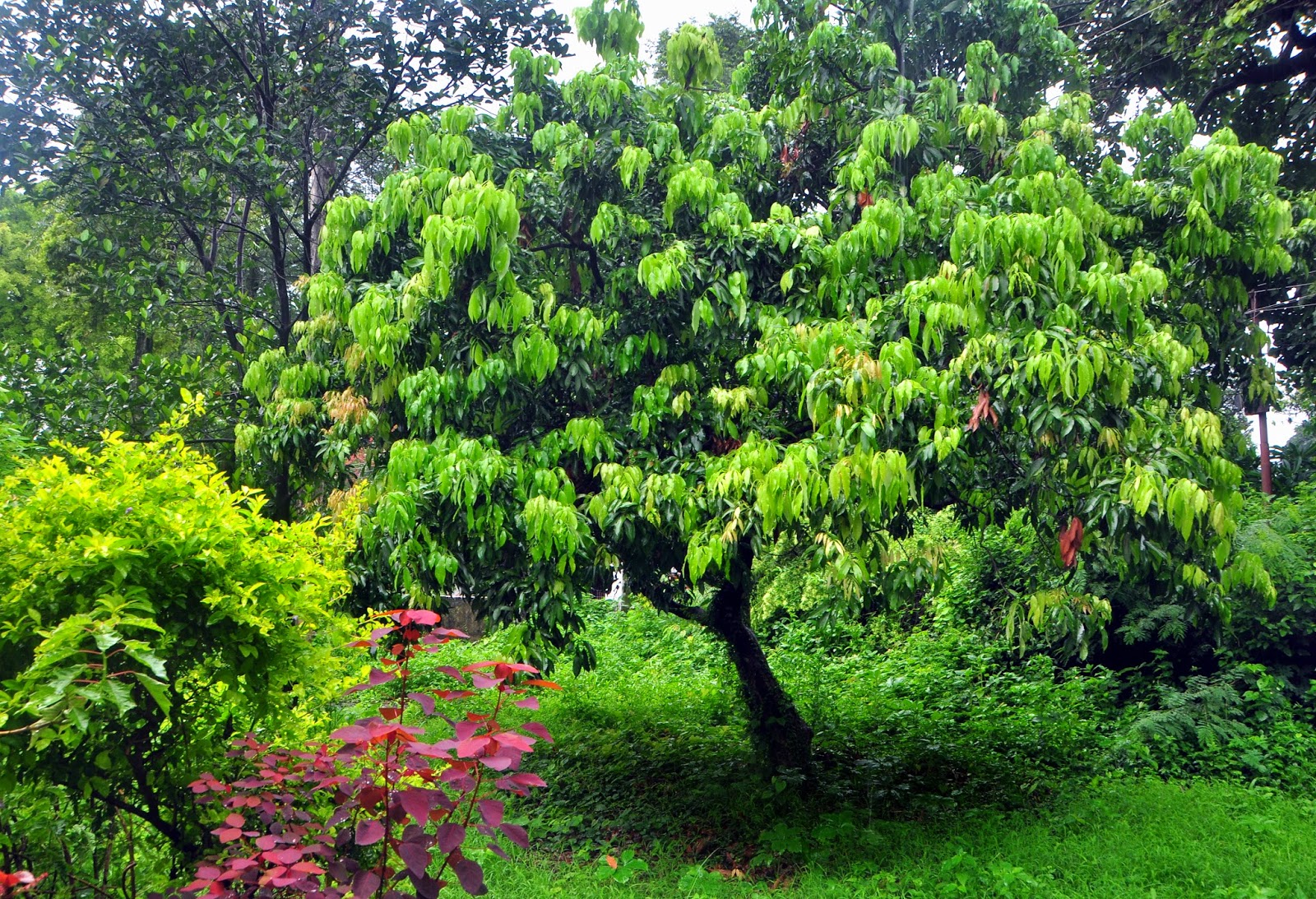
Monsoon in Dehradun was not so much of a stormy exclamation mark as an implacable ellipsis bearing much endlessness. It set about its task with a grave playfulness that went on for days. It made the leaves glossy and full and the grass irrepressible. It did not let up even after the snails, earthworms and the occasional snake had emerged. Those that did not resist it – like trees and street children – become merry and redolent of life. Those that did resist – like the house, or people – became creakier, leaky and full of unexpected little crises like falling plaster and fungal infections.

Ma was right. The wet and harassed dogs always managed to make their way within – at least one of the six doors that led into the house was bound to be ajar, at least one of the people who lived there was bound to develop a compassionate chink in their soggy armour. Once in, they would take up a safe position under the dining table, tuck both paws under their chin and settle down to looking at the wet world with silent reproach.


The world seemed composed entirely of grey-black nimbus and a charged sky. Tiny human-scale houses and trees give them scope and context. The water condensed and fell, condensed and fell, like this would now be the natural order of things forever. It fell on this patch of the earth which had been woodland next to a river – a pahaadi naala called Rispana – just a few decades before I was born. It seeped into the soil and nourished and replenished and made fecund. It became the root of a new grass shoot, a stronger tree root. It made its way to the food chain, it played its part in the water cycle, it inveigled itself into the sensual sequence, it thickened the emotional circuit.


It’s not just the cloud-drop-earth continuum that makes the rain, we know. Rain is being made here on Baba’s forearm as he shivers and draws the khes – lighter than a blanket, heavier than a sheet – upon him. It’s being made here in didi’s desire for something crunchy and oily. Here, as we bite into that pataud, looking out of the window at the downpour, our tongues sharp with desire. Chachi and Ma have no choice but to worry about clothes not drying in time, but I can allow the cold moist wind to make my 15-year-old self feel a beauty and longing I don’t understand. Vaporous and being pulled, like the drops pulled by gravity. The rain is inside, on the skin, somewhere in the gut.


Tuesday, 1 July 2014

The Laughter Memoirs - JNU 4

For unsuspecting newcomers to the university, the mysterious terminologies of the left were laid out like a minefield-with-a-social-conscience. It felt like everyone but you knew what Dialectical Materialism, False Consciousness, Hegemony, and – of course – Lumpen Proletariat meant. When occasion demanded, the practiced ones could even take the sibilance available in Superstructure and deploy it with hissy venom in the entirely non-sibilant Comprador Bourgeoisie.

I used to mostly feel like a tiny shred of pickled carrot in a plate full of hefty aloo paranthas. But PK was a big help amid the heavy artillery, explaining to well-meaning seniors who suggested that he read Capital Volume 3: “See, I haven’t read Marx, Marx hasn’t read me, we are equal”. On the other hand, it wasn’t easy to take any such line with people like Raghav, who could take a trembling, malnourished statement like “Sorry, I can’t lend you my pen because I’m using it”; single-handedly attack himself with it; counter-attack with an emotional pitch on private property and state; and demolish you with that most terrifying of epithets: Bourgeoise!

Many of us worked fairly hard at not being bourgeoise. I, for instance, wore lungis and bathroom slippers, and read books while walking about on the campus roads (this is less dangerous than it sounds because it was a mostly vehicle-free campus). Those who date their peptic ulcers or falling hair to seeing me in that avatar some two decades back would be pleased to know that they were thoroughly avenged several years later.

At a film festival I was introduced to an erstwhile JNU student whom I didn’t know. But he clearly knew me. “I remember Zugghi”, he announced sorrowfully, his Malayali accent entirely unaffected by the vodka he was holding in a Limca bottle. “When I zaw her 10 yearz back, zee was reading.”Pause for a while as he looked at his feet. “In a buz”, he clarified. Pause as he rocked on his heels. Then, looking at the festival brochure in my hand, he said with a defeated sadness that still haunts me, “zee is ztill reading”.
(For the record, he then firmly grabbed a passing intellectual, caught hold of a fleeting Malayali cinematographer, introduced them to each other in two crisp sentences, stepped back in a marvel of wobbly decisiveness and commanded: “Have dialogue!”)

On full moon nights, the university resonated with legends of our senior non-bourgeoise worthies. Back in the 80s, one of them had painted on the wall of his hostel room: “The theory of Communism may be summed up in the single sentence: abolition of private property”. Having looked at it long enough he decided – as political parties of the day often threatened – to take ‘direct action’. This consisted of taking pillows, books, ashtrays and sundry such objects from his first-floor room and throwing them to the well-populated depths below.
His roommate arrived to find his undeniably private property – socks, diaries, chappals – raining down like the quality of mercy, as a mess worker gathered them and put them to one side. The boggled roommate then had to conduct a simultaneous dialogue, shouting up at his friend (“Throw away your private property, not mine!” “No, no! All property must be destroyed”…), and expostulating with the mess worker (‘Sir, shall I take this bed sheet then?” “No, put it down, its mine”…).


The feeling of community and fellow traveler-dom that was generated amid all this was an act of constantly unfolding beauty. When Shom finished his PhD (remember the one it took 7 years to not do?) his friend and batchmate, who was clearly taking even the 8th year to not do, came by in the evening in a thrall of emotion. “You did it man”, he said, embracing Shom in a warm and liquid hug. “I did it”, Shom agreed, “I did it for both of us” (he, on his celebratory 3rd peg, was moist if not commensurately liquid). “You did it for both of us”, agreed the friend, his words muffled since he was kissing Shom’s ear profoundly. He then proceeded to kiss Shom 17 times, knocked off his specs in an expansive gesture, lay down on the floor and peacefully went to sleep. Shom still gets extremely sentimental when he remembers the episode… 

Monday, 28 April 2014

The Laughter Memoirs - JNU 3

The day would often set  on our liquid glasses, mostly steel ones from the hostel mess, as someone put on a cassette – Kishore Kumar or Mohammed Rafi for choice. Or as some friend, more multifaceted than our gathering, burst in with the day’s campus headlines (The Vice Chancellor is doing dirty politics on that issue!… Administration is closing down Francis’s canteen because the right wingers are pressurising them!... Feminists have brought out a pamphlet against neutering campus dogs!...) 

Rohit would, in the midst of all this, insist on us appreciating how tough his life was. We’d settle down to the evening’s entertainment. He had spun two complicated and conflicting stories about why his non-work was in the state of non-progress that it was -- one for his thesis advisor and one for his family -- and with great difficulty managed that the two parties not get in touch. But his atrocious professor didn’t exactly seem to believe that there had been a theft in the house, and his Bhabhi had actually called up the friend’s house where Rohit claimed he was staying and working but obviously wasn’t…

As we grew more intoxicated, we would create our own little continents, alone or with whoever seemed to be led by the same firefly that night – a song, a joke, a grievance, a moon, a thought, a plan. One or two of us would step out for a walk. Sometimes a potential romance would peek out hopefully from behind the unmoving keekar tree. Sometimes the night would drive us to an excess of sensuous sentimental despair as Rahul recited in Bengali: “Chai go, ami tomake chai, tomake ami chai”, I want you, I want you, I want you… .

And we’d return to the room, as best described on T Shirts, Same Same But Different.

“…If you haven’t heard the Malayalam songs by Salil Choudhury, you’ve not really heard him at all”.
“Accha? In Malayalam?”

“Don’t worry about the term paper man, just give some angles”
“I’ll give angles but will he give Marx?”

 “Arre woh to poems bhi likhta hai bhai!”
“Haan, behnchod, mujhe bhi dikhayi thi! Tumhe wo ‘Individuation of the Self’ wali dikhayi?”

“Chalein? kucch grass ka jugaad hai?”
“Chalo, the dhaba will close”

 “You people don’t know with what difficulty I convinced Bhabhi that I’ve been…”

“What, drinking the midnight oil?”

Friday, 7 March 2014

The Laughter Memoirs - JNU 2

It was only at a slow and melodic pace that the JNU phenomenon called Doing My PhD revealed itself. You could see them dotted all over the campus, students Doing Their PhD… as they agreed to have a fourth cup of tea at the dhaba; conducted lavish romances on tree-lined lanes; sat in the library with UPSC study notes; explained to their Professors how ill their mother had been; argued furiously over the reservation policy, wrote pamphlets on fascism taking over the campus; or moved from hangover to intoxication with just a bun-omelette in between.

“Does it take seven years to do a PhD”, asked a wide-eyed non-JNU innocent addressing the question to Rahul, who was at that precise point on his 1st bun-omlette, 3rd tea, 4th romance, and 17th pamphlet. She addressed the question to him, quite correctly, since he was in his seventh year if you included his M Phil phase, and was utilizing the happy facility of a year’s special extension. “Does it take seven years to do a PhD”? “No”, Rahul answered with his usual gravity and exactitude, “ but it takes seven years to not do the PhD”.

I had seen some of the Not Doing close at hand. I’m sadly unable to give a first-hand account of Not Doing my own PhD since I had utilized the two years given to me for an MA in Not Doing the MA itself. So that had put paid to that. But the fascinating methods of my friends that I was privileged to observe were worth recording.

For Raju, for example, it meant buying prodigious quantities of assorted stationery and files in pink and green, in which he would Organise My Notes. When the inspiration took him, he would snatch a fresh file, a dark sketch pen and a ruler, neatly write his name on the top right corner, neatly inscribe the topic in the centre, underline it with the help of the ruler, and say NOTES in brackets beneath. Before getting on with it, however, he would be struck by the fact that since his dissertation had a contemporaneous relevance, he had thought of collecting newspaper clippings too. He would rub his hands in satisfaction – the newspaper reports were the most important resource of the lot. He would now pull out a different coloured file, write “newpaper clippings” on it, underline with a ruler and, as a considered afterthought , write his name on top.

At this point it would become obvious to him that a riot of heterogeneous news clippings in one file would be eventually catastrophic ; no work could proceed till he had made several files for different sub-topics. He would mentally recount the number of sub-topics (what a thesis this was going to be, though!) He would count the number of unused files left, and tally them with the sub-topics. The files would fall short.

It didn’t exactly feel right to start work until all the necessary tools for organizing that work were in place. He would thoughtfully pull at his beard as he compared the time it would take to walk to the stationery shop and the time left for lunch. It was inevitably too close to lunch and the project was postponed to tomorrow (there being an important dharna in the evening).

Years after I left the university, I kept meeting its PhD students in the nearby markets of Munirka or Ber Sarai. There I would be, my head full of salary complications or grocery lists, and on the horizon would emerge some just-about remembered face. Guilty at having forgotten his name, I would smile with emphasized enthusiasm and ask “kaise hain”? His answer would assume that the entire world shared the speaker’s context and concern. In just the tone you would use to reply, “Buss… badhiya hain”, or “Buss… chal raha hai”, he would say “Buss… submit kar rahe hain”.

And I would go back home happy with my phool gobhi and toilet cleaner, like someone having unexpectedly been given comfort food in a foreign land.