Friday, 29 August 2014

The Laughter Memoirs - Dehradun 3

Years later, when I called up home from a sweltering Delhi in July – full and tense like a fat raindrop hanging from the roof ledge and unable to fall – I would try to recover some of the heady atmosphere of the mossy, incessant, cold rain of my childhood. On phone, my laughing Ma would put my yearning in place. Yes, saawan-bhado is here, she’d say… yes, you’re right, it’s indeed barkha bahaar... and the whole house is fragrant with the smell of wet dog…”.


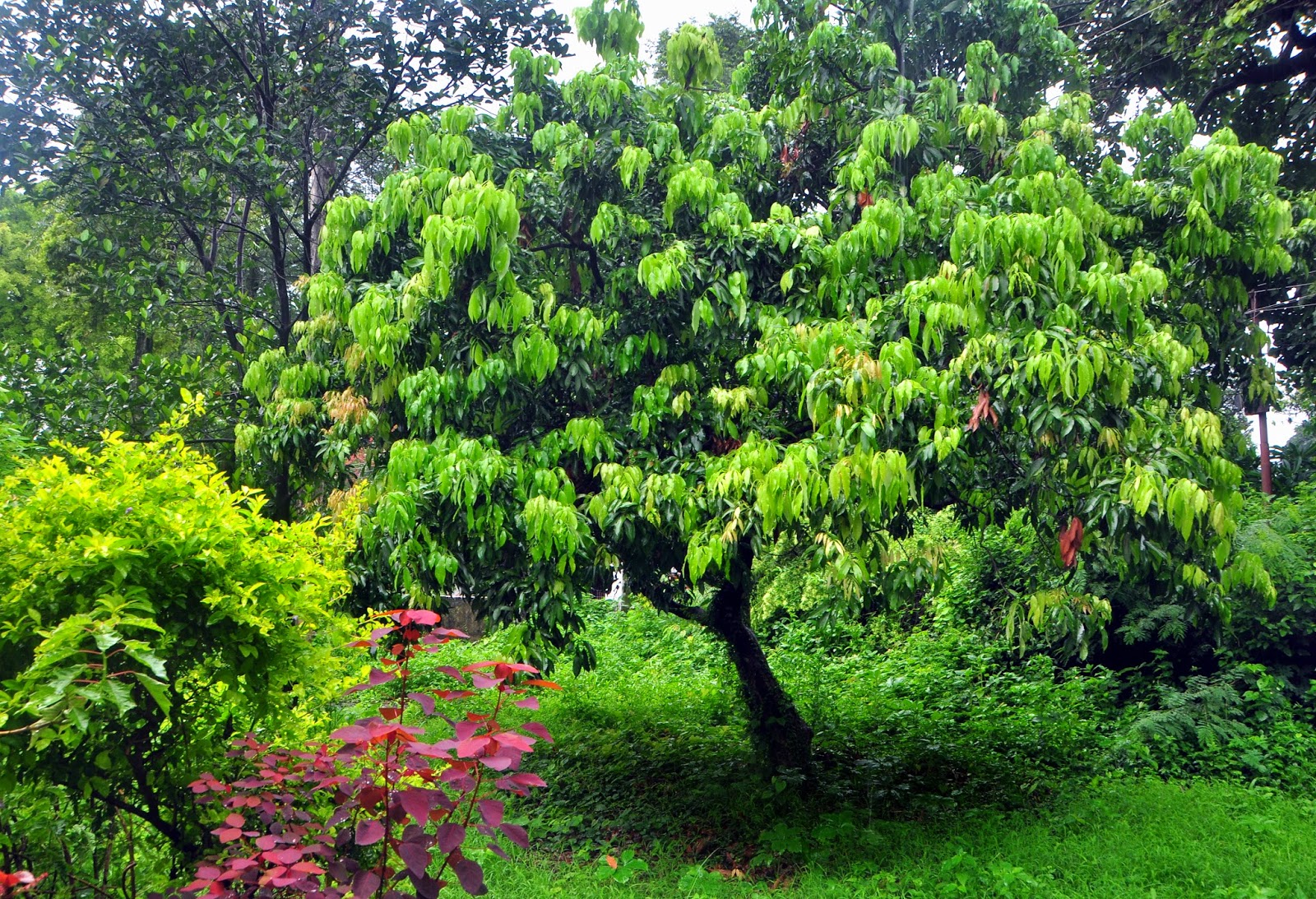
Monsoon in Dehradun was not so much of a stormy exclamation mark as an implacable ellipsis bearing much endlessness. It set about its task with a grave playfulness that went on for days. It made the leaves glossy and full and the grass irrepressible. It did not let up even after the snails, earthworms and the occasional snake had emerged. Those that did not resist it – like trees and street children – become merry and redolent of life. Those that did resist – like the house, or people – became creakier, leaky and full of unexpected little crises like falling plaster and fungal infections.

Ma was right. The wet and harassed dogs always managed to make their way within – at least one of the six doors that led into the house was bound to be ajar, at least one of the people who lived there was bound to develop a compassionate chink in their soggy armour. Once in, they would take up a safe position under the dining table, tuck both paws under their chin and settle down to looking at the wet world with silent reproach.


The world seemed composed entirely of grey-black nimbus and a charged sky. Tiny human-scale houses and trees give them scope and context. The water condensed and fell, condensed and fell, like this would now be the natural order of things forever. It fell on this patch of the earth which had been woodland next to a river – a pahaadi naala called Rispana – just a few decades before I was born. It seeped into the soil and nourished and replenished and made fecund. It became the root of a new grass shoot, a stronger tree root. It made its way to the food chain, it played its part in the water cycle, it inveigled itself into the sensual sequence, it thickened the emotional circuit.


It’s not just the cloud-drop-earth continuum that makes the rain, we know. Rain is being made here on Baba’s forearm as he shivers and draws the khes – lighter than a blanket, heavier than a sheet – upon him. It’s being made here in didi’s desire for something crunchy and oily. Here, as we bite into that pataud, looking out of the window at the downpour, our tongues sharp with desire. Chachi and Ma have no choice but to worry about clothes not drying in time, but I can allow the cold moist wind to make my 15-year-old self feel a beauty and longing I don’t understand. Vaporous and being pulled, like the drops pulled by gravity. The rain is inside, on the skin, somewhere in the gut.


Tuesday, 1 July 2014

The Laughter Memoirs - JNU 4

For unsuspecting newcomers to the university, the mysterious terminologies of the left were laid out like a minefield-with-a-social-conscience. It felt like everyone but you knew what Dialectical Materialism, False Consciousness, Hegemony, and – of course – Lumpen Proletariat meant. When occasion demanded, the practiced ones could even take the sibilance available in Superstructure and deploy it with hissy venom in the entirely non-sibilant Comprador Bourgeoisie.

I used to mostly feel like a tiny shred of pickled carrot in a plate full of hefty aloo paranthas. But PK was a big help amid the heavy artillery, explaining to well-meaning seniors who suggested that he read Capital Volume 3: “See, I haven’t read Marx, Marx hasn’t read me, we are equal”. On the other hand, it wasn’t easy to take any such line with people like Raghav, who could take a trembling, malnourished statement like “Sorry, I can’t lend you my pen because I’m using it”; single-handedly attack himself with it; counter-attack with an emotional pitch on private property and state; and demolish you with that most terrifying of epithets: Bourgeoise!

Many of us worked fairly hard at not being bourgeoise. I, for instance, wore lungis and bathroom slippers, and read books while walking about on the campus roads (this is less dangerous than it sounds because it was a mostly vehicle-free campus). Those who date their peptic ulcers or falling hair to seeing me in that avatar some two decades back would be pleased to know that they were thoroughly avenged several years later.

At a film festival I was introduced to an erstwhile JNU student whom I didn’t know. But he clearly knew me. “I remember Zugghi”, he announced sorrowfully, his Malayali accent entirely unaffected by the vodka he was holding in a Limca bottle. “When I zaw her 10 yearz back, zee was reading.”Pause for a while as he looked at his feet. “In a buz”, he clarified. Pause as he rocked on his heels. Then, looking at the festival brochure in my hand, he said with a defeated sadness that still haunts me, “zee is ztill reading”.
(For the record, he then firmly grabbed a passing intellectual, caught hold of a fleeting Malayali cinematographer, introduced them to each other in two crisp sentences, stepped back in a marvel of wobbly decisiveness and commanded: “Have dialogue!”)

On full moon nights, the university resonated with legends of our senior non-bourgeoise worthies. Back in the 80s, one of them had painted on the wall of his hostel room: “The theory of Communism may be summed up in the single sentence: abolition of private property”. Having looked at it long enough he decided – as political parties of the day often threatened – to take ‘direct action’. This consisted of taking pillows, books, ashtrays and sundry such objects from his first-floor room and throwing them to the well-populated depths below.
His roommate arrived to find his undeniably private property – socks, diaries, chappals – raining down like the quality of mercy, as a mess worker gathered them and put them to one side. The boggled roommate then had to conduct a simultaneous dialogue, shouting up at his friend (“Throw away your private property, not mine!” “No, no! All property must be destroyed”…), and expostulating with the mess worker (‘Sir, shall I take this bed sheet then?” “No, put it down, its mine”…).


The feeling of community and fellow traveler-dom that was generated amid all this was an act of constantly unfolding beauty. When Shom finished his PhD (remember the one it took 7 years to not do?) his friend and batchmate, who was clearly taking even the 8th year to not do, came by in the evening in a thrall of emotion. “You did it man”, he said, embracing Shom in a warm and liquid hug. “I did it”, Shom agreed, “I did it for both of us” (he, on his celebratory 3rd peg, was moist if not commensurately liquid). “You did it for both of us”, agreed the friend, his words muffled since he was kissing Shom’s ear profoundly. He then proceeded to kiss Shom 17 times, knocked off his specs in an expansive gesture, lay down on the floor and peacefully went to sleep. Shom still gets extremely sentimental when he remembers the episode… 

Monday, 28 April 2014

The Laughter Memoirs - JNU 3

The day would often set  on our liquid glasses, mostly steel ones from the hostel mess, as someone put on a cassette – Kishore Kumar or Mohammed Rafi for choice. Or as some friend, more multifaceted than our gathering, burst in with the day’s campus headlines (The Vice Chancellor is doing dirty politics on that issue!… Administration is closing down Francis’s canteen because the right wingers are pressurising them!... Feminists have brought out a pamphlet against neutering campus dogs!...) 

Rohit would, in the midst of all this, insist on us appreciating how tough his life was. We’d settle down to the evening’s entertainment. He had spun two complicated and conflicting stories about why his non-work was in the state of non-progress that it was -- one for his thesis advisor and one for his family -- and with great difficulty managed that the two parties not get in touch. But his atrocious professor didn’t exactly seem to believe that there had been a theft in the house, and his Bhabhi had actually called up the friend’s house where Rohit claimed he was staying and working but obviously wasn’t…

As we grew more intoxicated, we would create our own little continents, alone or with whoever seemed to be led by the same firefly that night – a song, a joke, a grievance, a moon, a thought, a plan. One or two of us would step out for a walk. Sometimes a potential romance would peek out hopefully from behind the unmoving keekar tree. Sometimes the night would drive us to an excess of sensuous sentimental despair as Rahul recited in Bengali: “Chai go, ami tomake chai, tomake ami chai”, I want you, I want you, I want you… .

And we’d return to the room, as best described on T Shirts, Same Same But Different.

“…If you haven’t heard the Malayalam songs by Salil Choudhury, you’ve not really heard him at all”.
“Accha? In Malayalam?”

“Don’t worry about the term paper man, just give some angles”
“I’ll give angles but will he give Marx?”

 “Arre woh to poems bhi likhta hai bhai!”
“Haan, behnchod, mujhe bhi dikhayi thi! Tumhe wo ‘Individuation of the Self’ wali dikhayi?”

“Chalein? kucch grass ka jugaad hai?”
“Chalo, the dhaba will close”

 “You people don’t know with what difficulty I convinced Bhabhi that I’ve been…”

“What, drinking the midnight oil?”

Friday, 7 March 2014

The Laughter Memoirs - JNU 2

It was only at a slow and melodic pace that the JNU phenomenon called Doing My PhD revealed itself. You could see them dotted all over the campus, students Doing Their PhD… as they agreed to have a fourth cup of tea at the dhaba; conducted lavish romances on tree-lined lanes; sat in the library with UPSC study notes; explained to their Professors how ill their mother had been; argued furiously over the reservation policy, wrote pamphlets on fascism taking over the campus; or moved from hangover to intoxication with just a bun-omelette in between.

“Does it take seven years to do a PhD”, asked a wide-eyed non-JNU innocent addressing the question to Rahul, who was at that precise point on his 1st bun-omlette, 3rd tea, 4th romance, and 17th pamphlet. She addressed the question to him, quite correctly, since he was in his seventh year if you included his M Phil phase, and was utilizing the happy facility of a year’s special extension. “Does it take seven years to do a PhD”? “No”, Rahul answered with his usual gravity and exactitude, “ but it takes seven years to not do the PhD”.

I had seen some of the Not Doing close at hand. I’m sadly unable to give a first-hand account of Not Doing my own PhD since I had utilized the two years given to me for an MA in Not Doing the MA itself. So that had put paid to that. But the fascinating methods of my friends that I was privileged to observe were worth recording.

For Raju, for example, it meant buying prodigious quantities of assorted stationery and files in pink and green, in which he would Organise My Notes. When the inspiration took him, he would snatch a fresh file, a dark sketch pen and a ruler, neatly write his name on the top right corner, neatly inscribe the topic in the centre, underline it with the help of the ruler, and say NOTES in brackets beneath. Before getting on with it, however, he would be struck by the fact that since his dissertation had a contemporaneous relevance, he had thought of collecting newspaper clippings too. He would rub his hands in satisfaction – the newspaper reports were the most important resource of the lot. He would now pull out a different coloured file, write “newpaper clippings” on it, underline with a ruler and, as a considered afterthought , write his name on top.

At this point it would become obvious to him that a riot of heterogeneous news clippings in one file would be eventually catastrophic ; no work could proceed till he had made several files for different sub-topics. He would mentally recount the number of sub-topics (what a thesis this was going to be, though!) He would count the number of unused files left, and tally them with the sub-topics. The files would fall short.

It didn’t exactly feel right to start work until all the necessary tools for organizing that work were in place. He would thoughtfully pull at his beard as he compared the time it would take to walk to the stationery shop and the time left for lunch. It was inevitably too close to lunch and the project was postponed to tomorrow (there being an important dharna in the evening).

Years after I left the university, I kept meeting its PhD students in the nearby markets of Munirka or Ber Sarai. There I would be, my head full of salary complications or grocery lists, and on the horizon would emerge some just-about remembered face. Guilty at having forgotten his name, I would smile with emphasized enthusiasm and ask “kaise hain”? His answer would assume that the entire world shared the speaker’s context and concern. In just the tone you would use to reply, “Buss… badhiya hain”, or “Buss… chal raha hai”, he would say “Buss… submit kar rahe hain”.

And I would go back home happy with my phool gobhi and toilet cleaner, like someone having unexpectedly been given comfort food in a foreign land.


Thursday, 9 January 2014

Travels: Time in Black and White, Shimla

There’s the Christ Church in front of me. It is a famous heritage building in Shimla, an 1857 British colonial artifact, by now quite literally a monument to time, shining with a fresh coat of paint as tourists take photographs with digital cameras in front of it. There’s the same Christ Church by my side, in the display shelf of a photo studio. This time it appears in black and white, romantically fading into a grey sky, with nothing but vast swathes of snow giving it context (sort of frozen in time, then). Further context is given by the coffee mug on which this black-and-white church presides. It’s a souvenir to be sold to tourists who come to Shimla.

For anyone who gives it a moment, and not just for a heritage-minded enthusiast, inevitably, the church-on-the-mug feels more ‘real’. The photograph hides what it carries most obviously and powerfully – appreciation of, and nostalgia created by, a black-and-white image, both for its evocation of an era long gone and its wistful beauty. It hides this seduction of black-and-white behind the form of the church (that has never been black and white in its 150 years old history, except in photographs) helping us make-believe: “this is how the church must have looked once, when it stood in solitary splendor on this now crowded ridge”.

 It won’t help at this point to be reminded that even then, 150 years back, the church was freshly painted and coloured. It won’t help to be told that this photograph is simply a black-and-white reproduction taken in an age when the church (then about 30 years old) was, in fact, a rather new church. And it would be a nearly rude shock to be informed that it has been digitally printed on hundreds of mugs, mass produced for the District Commissioner of Shimla, so they could be given to conference delegates as a memento.

Desire is stronger than fact. Not for nothing does the photo studio completely eschew selling contemporary coloured photographs of Shimla’s heritage buildings on its mugs.


A view of the Shimla Mall on a souvenir mug

Wednesday, 20 November 2013

The Laughter Memoirs - Dehradun 2

Winter afternoons were precious. They would surrender to darkness sometimes as soon as 4.30, the impending night a guest that had come too early while we were still uncombed and disheveled. The silken sunlit theatre of these afternoons began with lunch, which everyone would pile on their plates carry outside to the nearest sunny spot.

It was the season of greens and salads and local citric fruits – like the tangy chakotra – and varieties of hilly daals – like tore – that we waited for from autumn onwards. The mooli salad with soft new leaves would make an entry on a huge plate, sprinkled with lemon juice that made it glisten in the sun, and red chilly powder that lent it a festive air; in the corner languished an accidental lemon pip with a secret sorrow. Then came the steaming daal, challenging the sun with its yellow heat, making rivulets amid mounds of white rice. Then the accompanying dish, which proceeded to raise the quilt-and-comforter feel of familiar food to the level of high art: Rich green paalak, cooked the Garhwali way, thickened with rice paste. Crisply fried mustard leaves laced with layers of besan. Golden kadhi, sour to just the right degree. “Aaaah, kafli today…”, an uncle would sigh – as one whose tantrum-prone lover had turned up after much beseeching – though kafli was made every Wednesday like clockwork.


Conversations over lunch often took an unexpected but fascinating turn. This usually stemmed from the fact that Dadaji was hard of hearing but reluctant to admit it, Chacha was hard of hearing but refused to do anything about it, Baba was absent minded but didn’t know it, and everybody’s mouth was full.

“I think Api can go stay at Mrs Sharma’s while studying in Delhi”, Dadaji would propose.

A chewy silence would prevail while everyone who had been able to hear him clearly commiserated with the unsuspecting family of Dadaji’s old friend, Dr Sharma, and tried to figure how to get them out of hosting my young cousin for 2 years. Dadaji got along perfectly with Dr Sharma who had short-term memory loss, and when she said “How is the rice Saklani sa’ab” and he replied “Tuesday”, neither of them felt they had lost anything.

“Dr Sharma’s will be convenient too; the metro line between her house and Connaught Place is starting in a year, I read in the paper today”, he’d bolster his argument.

“The Delhi Metro is excellent”, Chacha would opine, never having been on it and blithely unaware that his son’s future was being discussed.

“No, it’s starting in a year”, Dadaji would repeat his information.

“It started a looong time back, Pitaji,” Chacha would say with gentle pity, referring to the entire Delhi Metro project and looking at his father, the best-informed member of the family, with a patronizing smile. “Ask Juhi”, he would rally support as the family always did while arguing with the patriarch.

“Juhi? Api can’t stay with Juhi”, Dadaji would try to keep up gamely, “her house is too small”.

“No , no, it’s not small at all”, my father would unexpectedly enter the conversation, utterly oblivious of the context, bristling at the idea that anything regarding his daughter was being judged not good enough. “She deliberately does not want a big house, she has very different ideas.”

“Why would Api stay with Juhi?” Chacha would ask confused.

“Api? Stay with Juhi?”, my father would ask in alarm.

And both would look for explanation to their father. “Right, right…” Dadaji would strain to understand his sons, and fail, as he had much of his life.

Api meanwhile would be getting a military dressing down by our aunt’s husband, “Young man, you have nothing to say for yourself! It is your future they are talking about! Don’t slouch! When I was your age I was taking the responsibility for much of my family and paid for my own studies. I remember, when I went to Greece in 1952…”


Lunch over, the whole menagerie would disperse to find, quite literally, their places in the sun. Those whose rooms got sunlight went straight to warmed quilts. Those, whose rooms didn’t, would tarry, linger and delay, with perhaps a cup of coffee, in a chair that had already been dragged around the lawns and verandahs in determined pursuit of sunny spots for half the day.

In the sun it became increasingly hard to move. Through half-closed eye lashes we could see the bare movement of the shadow of the bottlebrush tree. A butterfly would flit past underlining the inertia of everything else. The warmth would become hypnotic. Very soon mumbled conversations about how sleepy rice could make you feel would die down.

Then the whole tableaux would find its fulfillment in a gentle open-mouthed nap. A benign sun would fill that valley of ours, a little bowl amid the gently pretty Shivalik hills, with its slanting rays. With Dadaji’s oiled skin shining a healthy red, Baba’s silver hair catching the light, an orange cat curled up near Chacha’s green socks, ma’s banana-yellow shawl, the family looked more than anything like a Dutch still-life oil painting of a fruit bowl. 

Friday, 8 November 2013

Travels: Anu – Work in Progress; Varanasi Junction

A railway station in India is not a place where people choose to spend time. It seems to be an essentially transitory space with a relentless march of anxious feet, tense bodies, harassed minds through the day, a space from where any sense of harmony or peace has exited forever. Beneath the veneer of a portal, however, lies a whole self-sustaining universe. Peopled by those who never quite leave.

The porters, vendors, rag pickers, informal hawkers, beggars, girls who are sex workers by night, boys who ran away from possibly abusive homes, the addicts, the destitute, and those who turn the threat of destitution into the possibility of survival every day, every same-old new day.

It’s an alien insecure world for me – and it doesn’t trust me either – but I make my way confidently through its unfamiliar terrain because I feel safe following this little heroine, all of 5 feet high, weighing some 45 kgs. For the last 2 years, 22-year-old Anu has made this her workplace and more, her vocation.

I see it all through Anu’s eyes. The platform is not really a platform but a ‘contact point’ for runaway, destitute or trafficked kids. The vendor is not a purveyor of goods but a possible ‘stake-holder’. The little flat a couple of minutes down from the station is ‘the shelter’. And all of this is a backdrop to the essential business of rescuing exploited children; physically and psychologically helping the runaways to return home; counselling floundering adolescents; teaching young sex workers about hygiene, disease, AIDS and contraception; offering some shelter – a bed, a bath, some food – to all. Eventually, holding out hope and practical options of schooling and perhaps more worthwhile employment.

Stay here and fight

Across a seemingly infinite wasteland of “girls can’t”, girls shouldn’t”, “girls must not”, Anu walks towards us with bleeding feet, grimly determined. She carries her own bandages and is her own doctor. I have rarely seen anyone so courageous and strong-willed. Painstakingly she has recreated herself – from a girl who was refused a bicycle to a working woman who bought one with her first salary; from a child who couldn’t continue studies after Class XII to a student-of-life who is paying for her own graduation; from a person who was not schooled in English (and is still quite unconfident about it) to a social activist who rattles off “liaisoning”, “stake holders” and “informal education classes” with ease. Compliment her on any of this and she credits the people who helped her and discusses how much more she has to achieve. Anu: the work-in-progress.

Everyday she comes to the railway station, having pedalled on the bicycle they said she couldn’t have, carrying a mobile phone they don’t want her to possess, doing a job they don’t want her to do so badly that her family has hardly spoken to her for quite some time.

The ‘they’ in Anu’s life is unfortunately her immediate family. A lot of her growing up memories as a child have to do with having her opinions not valued, her desires thwarted and her independent-mindedness questioned. That bicycle she couldn’t have – another threat of a girl becoming mobile, independent and potentially out-of-hand – still rankles. Good at her studies, Anu wanted to study in a school affiliated to the nationally well-respected CBSE board but was made to study in a state-affiliated school. She was not able to take up the science stream because the school that offered this was “too far”. When she chose the college of her preference her brother opined that the reputation of the college was not good, the boys there were indecent and the girls were ‘spoiled’. She gave plenty of arguments, which seem admirably reasonable – “how does it matter what others are like”? “I’m interested in studying, why would I necessarily become like them”? “Shouldn’t you trust your sister”? And even, “At least let me get admitted, and if you see any signs of my getting spoiled I will leave the college” – but none of this worked.

In anger, Anu, with financial help from a grandmother, obstinately joined the same institution for sewing classes. For her class material, she used to take leftover scraps from the tailoring shop of an acquaintance. But when the time came for her examination, she wasn’t able to get the requisite money together for the form and fees. She also tried to do a beautician’s course but couldn’t because the make up products were too expensive and no help was forthcoming from home.

It wasn’t a good life, it in fact didn’t feel like life at all, and Anu wondered if she should run away. She nearly took the drastic step once, she says, relating the episode with a lot of unexpected calmness and maturity. Ironically, it was at the railway station that is now fast becoming home to her that she sat and thought hard about leaving home. She stayed. “I’m really glad that I finally decided against it. At that stage, uneducated and vulnerable, I could have fallen prey to anyone. And anyway, the correct thing to do is to stay here and fight my battles from within.”

It turned out to be a good decision. One of the steps Anu took in fighting her battle from within was to get in touch with a friend whose relative worked for a local NGO. She joined them, underwent training and became, in her parlance, a ‘street educator’ for them. Anu recounts her early and unconfident days. “At my first workshop, I was literally trembling like a leaf because I would have to give my introduction and so many eyes would be looking at me. But with the help of my seniors and repeated practice I was able to participate in workshops and programmes and articulate whatever was necessary. I got over the shyness of stumbling over English words and phrases, got over the embarrassment of discussing reproductive hygiene and contraception in front of people, and with colleagues’ help I overcame family opposition to travelling to other towns for work-related programmes”.

So is this job her fulltime concern now? “Well, I have to get more skills and a graduation degree is very important in the world.” And so Anu is paying her own way, with her NGO salary, through a Bachelor’s degree in Social Work; a computer course (“it covers Microsoft Word, Excel and Powerpoint”, she says confidently); and a course in spoken English. There’s one more rather important thing that she has done with her salary. She has bought her 10-year-old niece – with whom she clearly has a mutual adoration society going – a bicycle. And as she tells me this, pure glee shining through her overwhelming poise and gravitas, I glimpse the triumphant child who lives on in the young woman. And I hear the voice that echoes in so many female heads: “I won’t let this happen to my daughters”.

The sweeper children Anu works with, rendered anonymous at her request

Making of an expert

Anu is such a mine of information on the station’s children that for a while I forget my role as an interlocutor and simply become a fascinated student. I may never get such an opportunity to talk to an expert on this subject, and expert she clearly is.

The children often run away because they are scolded or beaten at home, they imagine having freedom away from home, and are too young to know that how exploitative and brutalising the experiences that await them in the world can be. Anu and colleagues also watch out for trafficking. We can make them out, she says, because it’s usually a group of 5 or more children with only one or two adults supervising them. The language, the body language… is a give away. In such cases, we get in touch with the railway police and see that action is taken. The other day we found an infant girl abandoned in the garbage. We had to follow her case through to the City Magistrate who heads the child welfare committee. We then took her to the state orphanage as he directed.

A big part of her work is getting the station’s children – mostly boys – to engage with the shelter and start envisaging possibilities of a different life. Any station child, anytime of the day or night, is welcome to visit the shelter, have a talk, catch up on sleep or take a bath. For a nominal sum they also get meals. “We have to charge something for the food, otherwise these boys spend all their earnings on the whitener they are all addicted to. (At the station she points out to me how the boys soak a piece of cloth with the whitener used to correct typing errors and sniff it’s pungent, mildly intoxicating odours through the day). It is important that after a point they feel committed to the shelter”. Anu also teaches them informally with the help of charts and pictures. The shelter has paintings made by kids pasted all over the walls. The boys who become interested in alternatives are encouraged to enrol in a school run by the NGO on the outskirts of the town, well away from the station.

Anu spends a lot of her working day at the station, talking to auto drivers, taxi drivers, local police, railway police, hawkers, vendors, porters, station officials, TTEs and more. It’s an energetic saga of making sure that as many people as possible know about the NGOs work, are sensitised to the problem of these children and know that there is someone to contact if the need arises. Much of her time is simply spent with the kids in building rapport and making friends. “I have to be a friend, it doesn’t work if I am judgemental. They are mostly good fun and become quite fond of me. One of them said the other day protectively, ‘you should stop coming to the station, it’s a bad place.’ Well, if it’s such a bad place, I said, you stop coming here. I have to because of you. If you stop being here, I’ll have no need to come either”.

A woman among men

So what is this work like, being in the station all day, I ask. Surrounded by people so different from you? Do you get scared? Are you harassed?

And out come tumbling the stories. Anu’s narratives of work-related problems would have been very much like the harassment that many working Indian women face through the day – stares, gestures, innuendoes, comments, propositions, malign gossip, deliberate misrepresentation… -- except for two factors. One, that the overall atmosphere of the railway station netherworld can make the danger and insecurity much more acute than usual. And two, that Anu has an approach to these situations that, truth to tell, boggles the mind. She doesn’t give in to anger, frustration or a sense of humiliation. Nor does she accept situations fatalistically (as in, “what can be done, this is how things are”). She keeps her larger purpose of helping the station’s children as some kind of beacon always in sight and navigates her way through these shoals. “The railway police constables keep asking me to come and have tea with them. It is important that they know about our work; they are the ones we have to go to if we come across children being trafficked or exploited in some way. So I don’t fight with them. I just politely tell them that I don’t drink tea.”

“Once the sex worker girls told me, you shouldn’t come here, people say bad things about you.” “Who says bad things and what does he say,” asked Anu. ”Maybe I can talk to him and make him see things the right way”. It was a vendor who had apparently sent a message that he would pay Anu to sleep with him. “I made one of the girls take me to that vendor. I didn’t say anything to the vendor that would make this girl feel bad – if I had been outraged, as in ‘how dare you think of me as a sex worker’, she would have felt humiliated. I told him he was mistaken, that I spent a lot of time on the station and in company with these girls because that was the nature of my work. I then told him all about my work. See, anybody can become a useful aid in rescuing the children. One or two or even three people might ignore what I say or be cynical about it or get annoyed, but at least the fourth will listen.”

I am slightly dumbstruck at this amalgam of level-headedness, practicality, positiveness and engagement. Her sensitiveness to the sex worker is remarkable and shows how beautifully she is living out the politics and philosophy of her training. I may be appalled on her behave, but she tells me wisely, “samaj hee bigadta hai, par samaj hee banayega.” (It is from society, from the people around us, from the world that surrounds us that our problems will come, but it is from the same society that our solutions will also come). Anu is willing to give society a chance.

She narrates the time when she had to harshly scold an older boy for the sexual abuse of a younger child and turn him out of the shelter. Later, a colleague said that the boy was threatening to hit Anu with a stone. She went looking for him, calmly walked up to him and said, if it makes you happy and gives you peace, go ahead and hit me. I don’t mind. But let’s get it out of your system and move on. Of course, he didn’t hit me, she smiles. “Anyway I don’t feel all that unsafe here. These boys are quite protective towards me”. She knows them all by name, knows their individual histories, their quirks, their possibilities…


A homeless boy from the railway station sleeps at the shelter

Anu’s first will and testament

If all was ideal in the world, what would you dream of for yourself? She considers:

I already have two sources of great satisfaction and joy. One is when I come to the platform and the children come running to me happily, calling me Didi. And the second is when I escort a child home and his parents bless me and I feel this story has come to a satisfactory conclusion.

I want to continue working in this field and do better at it. I definitely do not want to stop working after marriage. My family keeps getting prospective grooms to see me and they keep warning me, “Don’t tell him you have a job.” But I can’t do it this way. When I get married I will let the boy know clearly that I work and intend to keep working. That I plan to finish my graduation. In fact, I don’t want to marry for another two years till I get my degree. There is no way I am going to be dependent on the goodwill and earnings of someone else, ever. I don’t want be wildly successful or have enormous wealth. Just enough to satisfy my needs, not be dependent on anyone, let my children have a future. And I want to be someone in my field. To make a bit of name, gain a bit of recognition. So that all these people who say today, ‘All this is impractical, come to your senses, we will see how long your obstinacy lasts’… all of them have to acknowledge, ‘Yes, she did something; yes, she became something. She is someone’.


[First published in Plan International’s Because I am a Girl – Voices of Change in India, 2011.]